
Plywood vs Particleboard Cabinets: What Actually Matters
'Is it plywood?' is the first question half our customers ask, and it is a good one — but the honest answer has more parts than yes or no. Where the material is (box, shelf, door panel, drawer bottom), how thick it is, how the edges are sealed and what the joints are made of all matter as much as the label. This guide explains the materials and lists what each of our lines uses, so you can compare with the doors open.
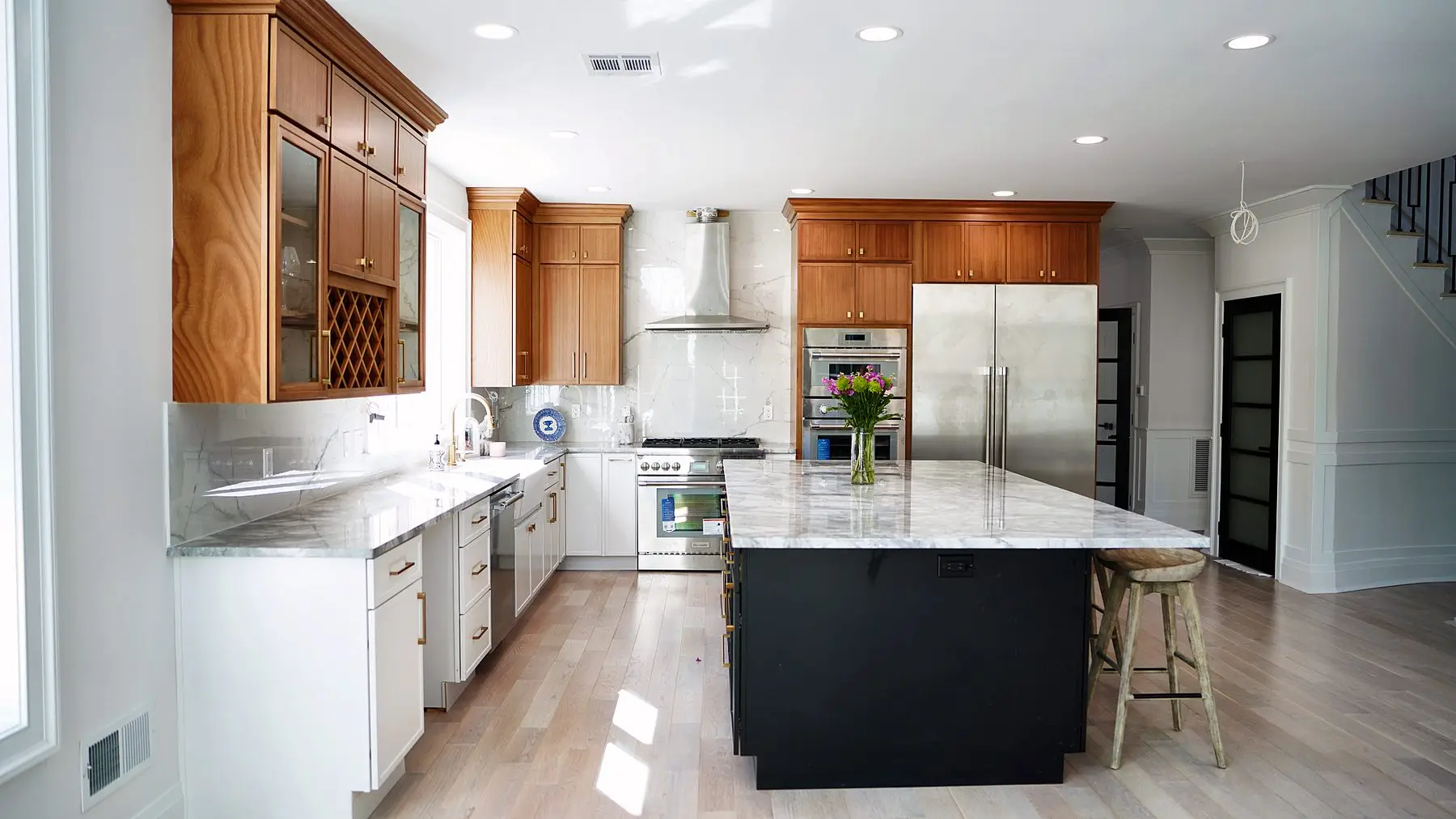
Petit Sand and Petit White kitchen with a Midnight black island — see this project
The materials
- Plywood — thin wood veneers glued in alternating grain directions. Strong for its weight, holds screws well, tolerates moisture far better than any composite, and is the box material of most of the lines we sell. Grades and thicknesses vary: ½-inch sides are common at the stocked level, ¾-inch in frameless lines.
- Particleboard — wood chips and resin pressed into a sheet. Inexpensive, flat and stable, but it swells if it gets wet, holds screws poorly, and crumbles at the edges if they are not sealed. The material of the cheapest cabinets, and of some very good European ones when it is dense, thick and fully edge-banded.
- MDF (medium-density fibreboard) — wood fibre and resin, finer and denser than particleboard. Dead flat and stable, which is why almost every manufacturer uses it as the centre panel of a painted door: a solid-wood panel would crack the paint at the joints as it moves with the seasons. MDF in a door panel is correct; MDF as a box is a cost cut.
- Furniture board / engineered board — the industry's name for a dense, high-grade particleboard with laminate or veneer faces and sealed edges, used in frameless European-style boxes. Durable in a dry location; still not something to put under a leaking sink.
Where it matters most
Under the sink and beside the dishwasher — the two places a cabinet gets wet — plywood is worth insisting on. For wall cabinets and dry base cabinets a thick, well-sealed furniture board box in a frameless line is perfectly durable and often flatter than plywood. For shelves, ¾-inch plywood or thick board that will not sag across a 36-inch span. For drawer boxes, solid wood dovetailed with a plywood bottom. For painted door panels, MDF — on purpose.
What each of our lines uses
| Line | Box | Doors and drawers |
|---|---|---|
| Forevermark | ½" plywood box, ¾" shelves | Solid-wood dovetail drawers; ¾" solid-wood face frame |
| FGM | ½" plywood sides and back, ¾" plywood full-depth shelves | ¾" solid-wood doors; dovetailed solid-wood drawers |
| J&K | ½"–⅝" plywood, clear-coat interior; no particleboard or MDF | ¾" solid-wood doors; ⅝" solid-wood dovetail drawers |
| 21st Century | Plywood sides, ¾" shelves | Solid-wood frames with HDF centre panels (painted); full solid-wood doors on the stained lines; dovetail drawers |
| WoodConcept | Seven-layer plywood with UV edge banding | Solid-wood mortise-and-tenon frames, MDF centre panel on Element; dovetail drawers |
| Adornus | ¾" plywood (Essential, Designer — CARB Phase II); Capri box ¾" plywood wrapped in laminate (Alusso); ½" plywood (Metropolitan) | Solid-wood stiles and rails with HDF panels; hardwood mortise-and-tenon on Designer; ⅝" hardwood dovetail drawers |
| Fabuwood | ½" plywood box with ¾" veneered plywood shelves (Allure); ¾" plywood box (Ovela); engineered board (Illume) | Solid-wood frames with CARB2 MDF centre panels (painted); solid-wood dovetail drawers; Blum MERIVOBOX metal drawers on Illume |
| Shiloh | ½" plywood sides, ⅜" plywood wall tops and bottoms, ¾" plywood shelves; 1½" solid-wood face frame | Solid-wood doors (engineered substrate on painted and Metropolitan); ⅝" hardwood dovetail drawers |
| Eclipse | ¾" box with laminate interiors; plywood upgrade in some species | Shiloh doors; ⅝" dovetail or simulated-metal drawers, ¾" dovetail with LEGRABOX as the premium |
| Kith, NOMA, St. Martin, Great Northern, Plain & Fancy, Crystal | Plywood boxes (see each catalogue page for the specification) | Hardwood doors; dovetail drawers |
Signs of a cabinet built down to a price
- Thin particleboard sides with unsealed, chalky edges you can scratch with a fingernail.
- Shelves that are ½-inch board and already bow in the display.
- Stapled or glued drawer boxes with a thin hardboard bottom.
- Hinges without soft-close or adjustment; drawer glides on the sides rather than underneath.
- A finish sprayed by the dealer instead of applied at the factory.
None of our fifteen lines does any of these, which is why the price ladder starts where it does.
Certifications worth knowing
KCMA certification (Shiloh, Eclipse, WoodConcept) means the line passed the Kitchen Cabinet Manufacturers Association's load, slam, heat and humidity tests. CARB Phase II and TSCA Title VI are formaldehyde-emission limits for composite wood — every line we sell meets them. ESP (Shiloh, Eclipse) is KCMA's environmental stewardship program. They are a baseline for durability and air quality, not a ranking.
Bottom line
Plywood under the sink and in the box, MDF in the painted door panel, solid wood in the drawers, sealed edges everywhere — that is the standard every line on our floor meets, from stocked to custom. The rest is thickness, hardware and finish, which you can judge with the doors open in the showroom. Cabinets 101 covers the whole cabinet; the catalogue pages list each line's construction.
Questions on this topic
Is plywood always better than particleboard?
Why is there MDF in my painted door?
Are any of your lines particleboard?
Does plywood thickness matter?
What about the drawers?
Is a KCMA label important?
Related guides

Cabinets 101: How Kitchen Cabinets Are Built and What to Look For
Boxes, doors, drawers, finishes and hardware explained in plain language, so you can compare kitchen cabinet lines at any New Jersey showroom.
Read the guide
Inset vs Framed (Overlay) vs Frameless Cabinets: Construction, Look, Cost and Storage
Inset, full-overlay framed and frameless cabinets compared on construction, look, storage and cost, with the lines that offer each at our NJ showrooms.
Read the guide
2027 Kitchen Trends We're Seeing in New Jersey Homes
The kitchen colors, woods, islands, hardware, counters and layouts New Jersey homeowners are choosing for 2027, from the floor of our three showrooms.
Read the guideTurn the reading into a plan.
Send this and a designer will call within one business day to arrange a showroom visit or a measurement. No obligation.
Or send the details and we'll call you