
Cabinets 101: How Kitchen Cabinets Are Built and What to Look For
Every kitchen we design starts with a version of the same question: what is actually inside these cabinets? It is a fair question, because two doors can look identical on a showroom floor and be built very differently behind the hinge. This guide walks through how cabinets are made, piece by piece, so you know what you are comparing and what you are paying for.
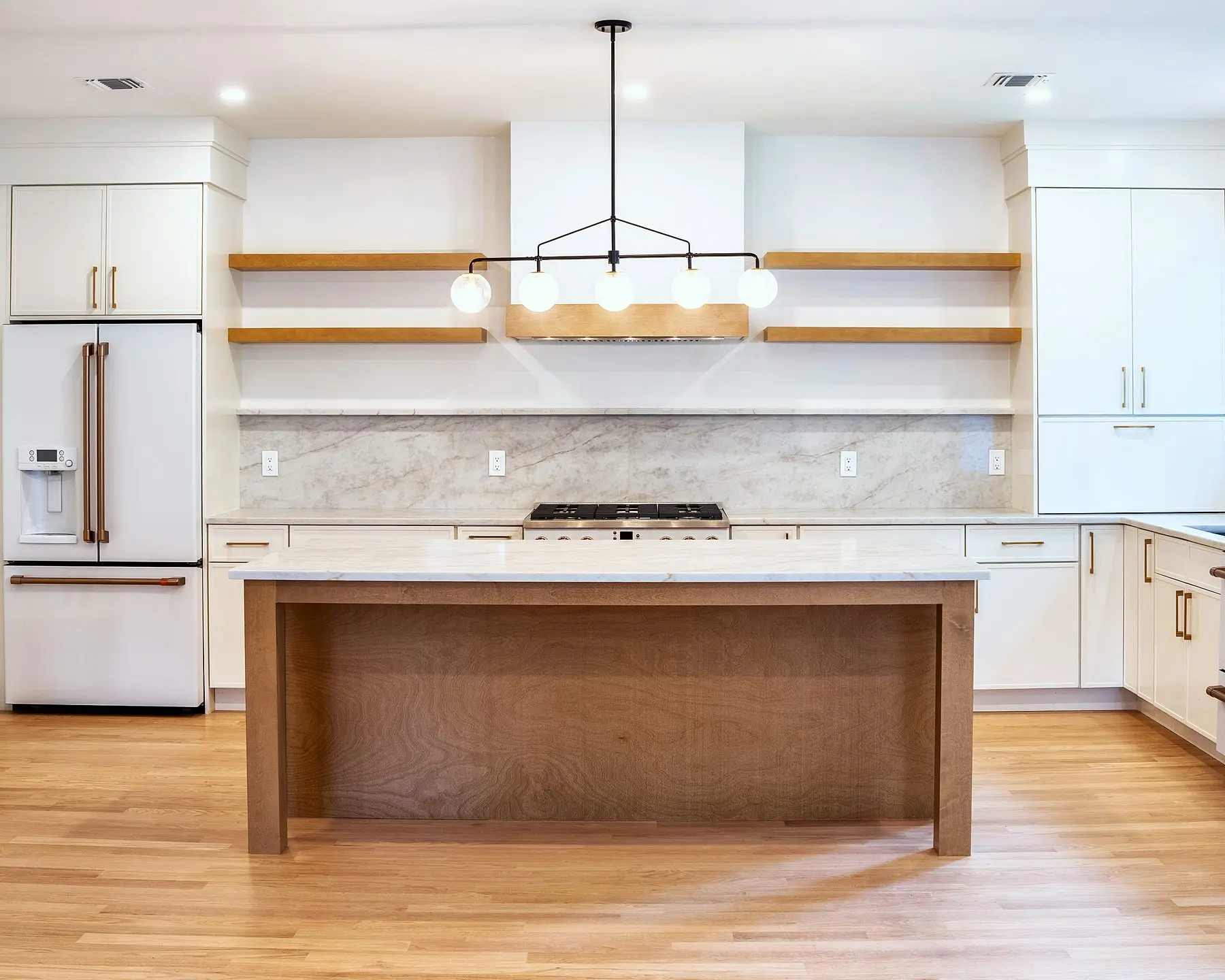
Dove slab kitchen with Timber island, floating shelves and marble-pattern quartz — see this project
The anatomy of a kitchen cabinet
Strip away the door and a cabinet is a simple thing: a box, a way to hang doors on it, and the moving parts inside. Once you know the names of the pieces, every other comparison gets easier.
- The box (or carcass): two sides, a top (or top stretchers on base cabinets), a bottom and a back. Everything else attaches to it.
- The face frame: on framed cabinets, a solid wood frame glued to the front edge of the box. Frameless cabinets skip it and finish the box edges with a thin banding instead.
- Doors and drawer fronts: the parts you see and touch every day, and the biggest driver of both style and cost.
- Drawer boxes: the hidden boxes behind the drawer fronts. Their joinery and material say a lot about a line.
- Hardware: hinges, drawer glides, and the pins or clips that hold adjustable shelves.
- Toe kick: the recessed strip at the floor that lets you stand close to the counter without kicking the cabinet.
When we walk a customer through our showrooms, we open doors and pull drawers on every display, because that is where the differences live.
Box materials: plywood, furniture board and MDF
The box material is the first thing to ask about. There are three common choices, and each has a legitimate place.
Plywood
Plywood is thin layers of wood veneer glued with the grain alternating in each layer. It is lighter than particleboard, holds screws well, and shrugs off a minor dishwasher leak better than the alternatives. Most of the lines we sell, including the in-stock ones, use plywood boxes as standard or as a modest upgrade.
Furniture board (particleboard)
Furniture board is compressed wood particles bonded with resin. Good furniture board is dense, flat and perfectly fine in a cabinet that stays dry. Its weak points are standing water and screw-holding at the edges. Many European-style frameless lines use it because it is dimensionally stable and takes laminate beautifully.
MDF
Medium-density fiberboard is finer than particleboard and very smooth, which is why you find it in painted doors and center panels more often than in boxes. It will not show the hairline seams that painted solid-wood doors develop as the seasons change.
We do not treat plywood as automatically good and furniture board as automatically bad. We care more about thickness, how the edges are sealed and how the pieces are joined.
How the box is held together
A cabinet can be assembled with dadoes (grooves that lock panels into one another), glue, dowels, screws, staples or some mix of them. The strongest boxes combine a mechanical joint with glue. Look at the back panel as well: a full-thickness back captured in a groove keeps the box square in transit and during install, while a thin back stapled on after the fact tends to rack. On base cabinets, check for corner blocks or an I-beam brace at the top; they stop the box from twisting when the countertop goes on.
Some in-stock lines arrive fully assembled and some arrive flat-packed. Either way, our crews check every box for square before it goes on the truck, because a box that is slightly out of square is the usual reason doors never quite line up afterward.
Doors and drawer fronts
Doors set the look of the kitchen, and there are only a few ways to build one.
- Five-piece (frame and panel): two vertical stiles, two horizontal rails and a center panel. Shaker, raised panel and most traditional doors are built this way. The center panel can be solid wood, veneered plywood or MDF.
- Slab: one flat piece, typically MDF with paint, laminate or veneer, or solid wood in higher-end lines. The usual choice in frameless kitchens.
- Thermofoil: a vinyl film heat-wrapped over MDF. Easy to clean and inexpensive, but it can lift near a range or a dishwasher vent, so we specify it carefully.
For painted doors, an MDF or veneered center panel is a feature, not a shortcut. Solid wood moves with humidity, and in New Jersey it moves noticeably between a damp August and a dry, heated January. That movement is what causes the thin lines you sometimes see at the joints of painted wood doors. For stained doors, solid wood is the norm and the grain is the point. Our guide to painted vs stained cabinets covers the trade-offs in depth.
Drawers, glides and hinges
Pull out a drawer in the showroom and look at the corners. Dovetail joints are the sign of a well-made drawer box, and nearly every line we carry includes them as standard. Solid wood drawer sides are typical; some frameless lines use metal drawer systems that are just as sturdy and often quieter.
Then look underneath. Undermount, full-extension, soft-close glides are the standard today; side-mounted epoxy glides are an older design that extends only three-quarters of the way out and shows the mechanism from the side. Hinges should be concealed, soft-close and adjustable in three directions so doors can be aligned after installation. A handful of specialist companies supply glides and hinges across the industry, so an in-stock cabinet and a custom cabinet are frequently riding on the same mechanisms.
Finishes: why factory finishes outlast site paint
A factory cabinet finish is not house paint. Stained doors get stain, sealer and a catalyzed conversion varnish or UV-cured topcoat that is baked hard in a controlled environment, so it resists grease, cleaners and daily wear far better than anything brushed on in a kitchen. Painted doors go through the same process with pigmented coats. This is why a factory-painted white door from an in-stock line will usually outlast a site-painted custom door.
Glazes, distressing and specialty finishes add steps, and they are more common in semi-custom and custom lines. A quick showroom test: run a fingernail along a door edge where the finish is thinnest. A good finish feels like a single hard shell, not a coat sitting on top of the wood.
Framed, frameless and overlay in one minute
Framed cabinets have a face frame, and the doors either overlay it (partially or fully) or sit inside it (inset). Frameless cabinets have no frame, so the doors cover the whole box. Full overlay and frameless give a cleaner look with less cabinet showing between doors. Inset is the most traditional and the most expensive, because of the precision involved in fitting each door into its opening.
Most of the lines in our showrooms are framed. Eclipse is our frameless line, and Shiloh, Great Northern, Plain & Fancy and Crystal offer inset. Our comparison of inset vs framed vs frameless cabinets goes into how each affects storage, cost and the final look.
Standard sizes and what modifications mean
Cabinet sizes follow conventions that have not changed in decades. Base cabinets are 34 and a half inches tall and 24 inches deep, so that with a countertop you land at a 36-inch work height. Wall cabinets are 12 inches deep (sometimes 15) and commonly 30, 36 or 42 inches tall. Widths run in 3-inch increments, usually from 9 to 48 inches.
In-stock lines stay inside these conventions. Semi-custom lines add depth and height changes and a longer list of accessories. Custom lines will build to any dimension you can draw. Fillers, panels and moldings bridge the gaps and finish exposed sides, and a designer's job is to use the increments cleverly so your money goes into cabinets rather than fillers. This is the real difference between the levels, which we explain in our guide to stock vs semi-custom vs custom cabinets.
What to look for on a showroom floor
Bring this list with you, whichever showroom you visit.
- Open doors and pull drawers. Feel the soft-close and look at the joinery at the corners.
- Ask what the box, the door, the drawer box and the center panel are each made of. Four different answers is normal.
- Ask whether the line is KCMA certified, which means it passed a standardized set of durability and finish tests.
- Ask about the warranty and, more importantly, who you call if a door arrives damaged or a hinge fails in year three.
- Compare the same door style across two levels so you can see what the extra money buys.
- Ask for a line-by-line quote that separates cabinets, accessories, moldings and installation.
We do that last one for every design, and our cabinet pricing guide explains how the levels differ before you ever ask for a number. You can see all of this in person at any of our showrooms in Union, Paramus and Rochelle Park.
Bottom line
Cabinets are a box, a door and the parts that move. Plywood or well-made furniture board, dovetail drawers, soft-close undermount glides and a factory conversion-varnish finish are the baseline we would want in any kitchen, and every line we carry, from in-stock to custom, meets it. The rest is style, size flexibility and finish options, which is what the levels are really about. Bring rough measurements and a few photos to Union, Paramus or Rochelle Park and we will design your kitchen in 3D for free, then show you the differences with the doors open. Browse all of our kitchen cabinet lines to get oriented first.
Questions on this topic
Is plywood always better than particleboard for cabinet boxes?
What does KCMA certified mean?
Do in-stock cabinets use the same hardware as custom cabinets?
How long should good kitchen cabinets last?
Related guides

Inset vs Framed (Overlay) vs Frameless Cabinets: Construction, Look, Cost and Storage
Inset, full-overlay framed and frameless cabinets compared on construction, look, storage and cost, with the lines that offer each at our NJ showrooms.
Read the guide
Painted vs Stained Kitchen Cabinets: Durability, Touch-Ups, Cost and What We See in New Jersey
Painted or stained kitchen cabinets? We compare durability, touch-ups, cost, wood species and what we see trending in New Jersey kitchens right now.
Read the guide
2027 Kitchen Trends We're Seeing in New Jersey Homes
The kitchen colors, woods, islands, hardware, counters and layouts New Jersey homeowners are choosing for 2027, from the floor of our three showrooms.
Read the guideTurn the reading into a plan.
Send this and a designer will call within one business day to arrange a showroom visit or a measurement. No obligation.
Or send the details and we'll call you