
Painted vs Stained Kitchen Cabinets: Durability, Touch-Ups, Cost and What We See in New Jersey
Paint or stain is usually the second decision in a kitchen, right after the layout, and it changes the species, the door construction, the price and how the kitchen ages. Neither is the right answer for everyone. Here is how the two finishes are made, how they hold up in a busy New Jersey household, and what we are seeing people choose in our showrooms.
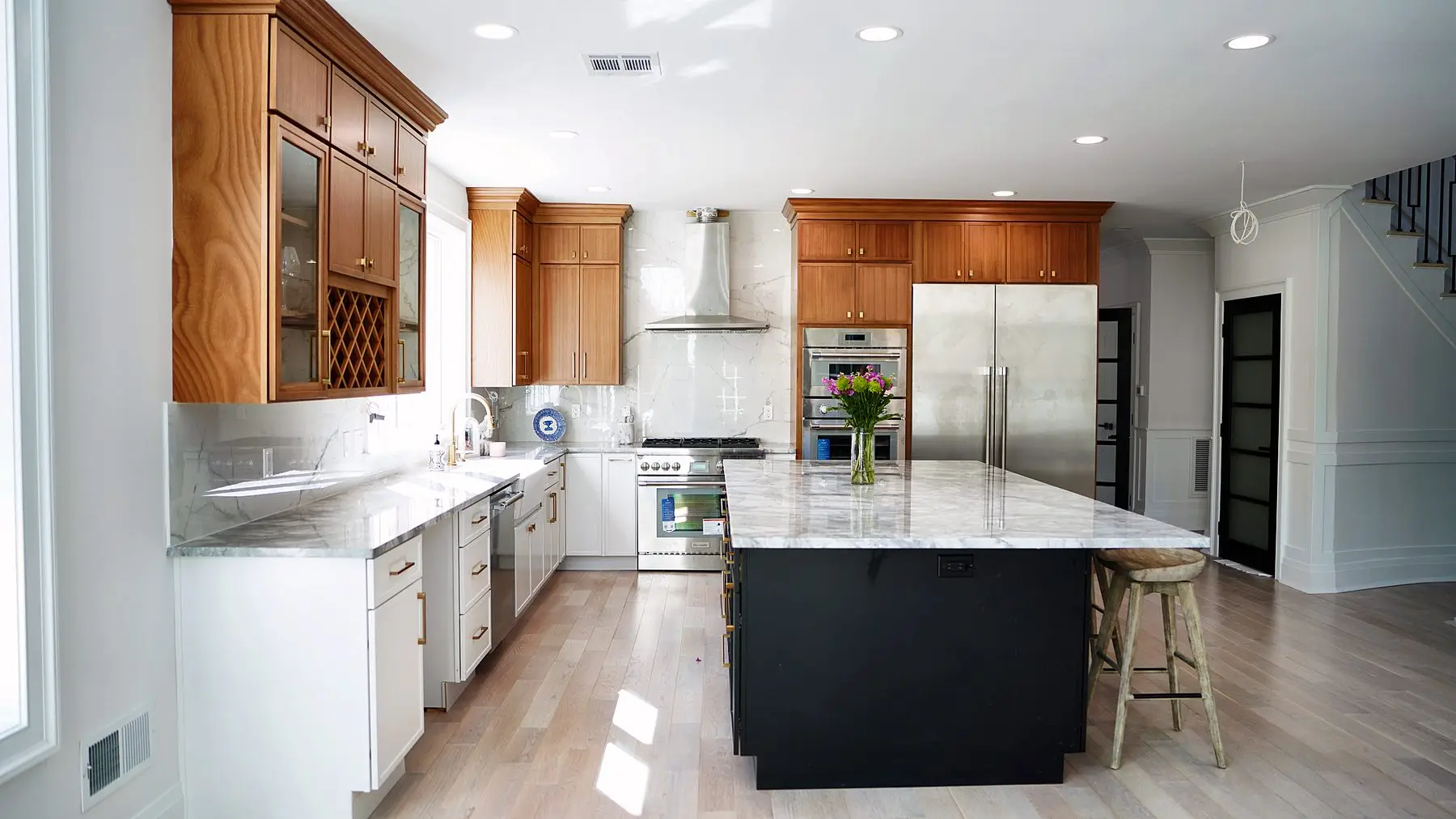
Petit Sand and Petit White kitchen with a Midnight black island — see this project
How a factory paint finish and a stain finish differ
Both start in the same spray booth. A stained door gets stain rubbed or sprayed into bare wood, then a sealer, then a hard catalyzed topcoat. The grain stays visible and the color comes partly from the wood itself, which is why the same stain looks different on maple than on oak.
A painted door gets a primer, pigmented color coats and the same kind of protective topcoat. The paint hides the grain completely (or nearly, on oak), so the color is exactly what the sample shows. In both cases, the factory finish is far tougher than anything applied in your kitchen with a brush. If you want the full picture of what is under the finish, our Cabinets 101 guide covers boxes, doors and topcoats.
Durability: what each finish shows over time
Stained cabinets are the more forgiving of the two. A small chip or scratch on a stained door exposes wood that is close in color to the finish, so it disappears from across the room. Grain and color variation hide fingerprints, dust and the faint wear marks that appear around the trash pull-out and the dishwasher.
Painted cabinets show everything a little sooner. The edges of doors and drawer fronts, the spot below the cabinet pull and the area around the sink are where paint wears first. On painted solid-wood doors, you will eventually see fine lines at the joints where the stiles meet the rails. That is not a defect; it is wood moving with the seasons under a rigid film. Manufacturers reduce it with MDF center panels, and some painted lines use MDF for the whole door so there are no joints to open at all.
Which lasts longer?
With a good factory topcoat, both last decades. The difference is cosmetic: stain ages gracefully and paint shows its age, especially in white and other light colors in a house with young children and a dog.
Touch-ups and repairs
Stained finishes are easy to touch up. Every line we carry supplies a matching touch-up marker or fill stick, and a scratch on a stained door can be made nearly invisible in a minute. Painted finishes are harder. A touch-up kit matches the color, but matching the sheen and feathering the edge of a brushed spot into a sprayed finish takes a careful hand, and a touched-up area can still be visible in raking light.
The practical answer for a painted kitchen is to order a couple of extra doors or a touch-up kit at the time of purchase, keep them in a closet, and swap a door rather than repaint it if one gets damaged years later. A manufacturer can also refinish a single door to match, which is far easier while the color is still in production.
Cost: why paint usually costs more
In semi-custom and custom lines, a painted finish typically carries an upcharge over a standard stain. The extra cost comes from more coats, more sanding between coats and a higher reject rate, because every speck of dust shows on a white door. Specialty paint colors and custom color matching add another step above that. In in-stock lines, the price is the same regardless of finish, because each line offers a small set of colors that are produced in volume.
Within stains, species drives the price more than the color does. A standard stain on maple or oak is the baseline; walnut and some exotic veneers cost noticeably more, often about a third more than the same door in maple. Our cabinet pricing guide explains how finish choices fit into the overall number.
Wood species for stained cabinets
If you are staining, the species is the design decision. These are the ones that come through our showrooms most.
- Maple: smooth and tight-grained, takes light and medium stains evenly, and is the usual species under paint too. Dark stains can look slightly blotchy on maple, which is a reason many lines offer dark colors on other woods.
- White oak: the species of the moment. Straight grain in rift and quarter-sawn cuts, warm tan color, and it takes natural, cerused and light stains beautifully. Our guide to white oak cuts explains the differences.
- Red oak: pronounced grain and a pinkish cast, the species of many older New Jersey kitchens. Still available, and handsome in a mid-tone stain, but it is requested far less often than white oak now.
- Cherry: fine grain, deepens to a rich reddish brown as it ages and sees sunlight. Classic in traditional inset kitchens.
- Walnut: deep chocolate tones with dramatic grain. Usually a natural or clear finish to show it off, and usually the most expensive option in a line.
- Hickory and alder: hickory for strong color variation and rustic character, knotty alder for a softer rustic look. Both appear in casual and farmhouse kitchens.
What is under the paint matters
Ask what a painted door is made of. Three answers are common, and all three are acceptable when they are done well.
- Solid maple frame with an MDF center panel: the most common build in semi-custom lines. The wood frame gives crisp edges and the MDF panel will not crack the paint.
- All-MDF door: no joints, so no joint lines ever, and very smooth paint. Heavier, and the edges need a good seal.
- Painted oak: the grain telegraphs through the paint as a subtle texture. Some people love it; most of our customers prefer the smooth look.
Thermofoil, a vinyl film wrapped over MDF, is sometimes sold as a painted look. It cleans easily and costs less, but it is not paint, and it does not take touch-ups or refinishing.
What we see in New Jersey kitchens right now
Painted kitchens still outnumber stained ones in our showrooms, but the gap is narrowing and the colors have shifted. Bright white is giving way to warm whites and creams. Greens from sage to deep olive, slate and navy blues, and soft greige and mushroom tones are the most requested accent colors, usually on an island or on the lower cabinets. Black and charcoal remain popular for a single feature run.
On the stained side, almost everything we are asked for is light and natural. Rift-cut white oak in a clear or barely-there stain leads, followed by walnut, with cerused and wire-brushed textures for people who want more character. The dark cherry and espresso kitchens of fifteen years ago are rarely requested now, and they are often the kitchens we are replacing. We keep a running list of these shifts in our guide to 2027 kitchen trends in New Jersey.
Mixing paint and stain in one kitchen
The most popular kitchens we design today use both. A painted perimeter with a stained wood island, or painted uppers over white oak lowers, gives the warmth of wood without the cost of a fully stained kitchen, and it hides the painted surfaces that wear fastest (the lowers) behind a forgiving stain. The trick is to treat one finish as the main color and the other as the accent, and to keep the undertones in the same family: warm white with white oak, cooler white with walnut. Our guide to two-tone kitchens goes through the pairing rules with examples.
Which of our lines do what
In-stock lines keep paint and stain to a tight, well-chosen palette. Fabuwood Signature, Forevermark, J&K, FGM, 21st Century and WoodConcept each offer a handful of whites, grays and stains that are ready to ship. Semi-custom lines like Fabuwood Allure, Kith, St. Martin, NOMA and Shiloh open up dozens of paint colors, stains on several species, glazes and textured finishes. Custom lines, Great Northern, Plain & Fancy and Crystal, will match a paint chip from any major paint brand and stain almost any species you can source. You can compare them all under our kitchen cabinets overview.
Bottom line
Choose stain if you want warmth, forgiveness and easy touch-ups, and you like the species you are looking at. Choose paint if you want a specific color and a smooth, clean look, and plan for a touch-up kit and a little more care at the edges. Choose both if you want the look everyone is asking for right now. Bring a paint chip, a photo of your floor and your rough measurements to any of our showrooms and we will put real door samples against them under the showroom lights.
Questions on this topic
Do painted cabinets chip easily?
Can I change the color of painted cabinets later?
Is white oak a painted or stained choice?
Which is better for resale in New Jersey?
Related guides

Cabinets 101: How Kitchen Cabinets Are Built and What to Look For
Boxes, doors, drawers, finishes and hardware explained in plain language, so you can compare kitchen cabinet lines at any New Jersey showroom.
Read the guide
Inset vs Framed (Overlay) vs Frameless Cabinets: Construction, Look, Cost and Storage
Inset, full-overlay framed and frameless cabinets compared on construction, look, storage and cost, with the lines that offer each at our NJ showrooms.
Read the guide
2027 Kitchen Trends We're Seeing in New Jersey Homes
The kitchen colors, woods, islands, hardware, counters and layouts New Jersey homeowners are choosing for 2027, from the floor of our three showrooms.
Read the guideTurn the reading into a plan.
Send this and a designer will call within one business day to arrange a showroom visit or a measurement. No obligation.
Or send the details and we'll call you