
White Oak Cabinets: Rift Cut vs Quarter Sawn vs Plain Sawn, Explained
White oak is the most requested wood in our showrooms right now, and the first thing we have to explain is that there is no such thing as plain white oak. The same tree can give you three very different-looking doors depending on how the log is cut. Here is what rift cut, quarter sawn and plain sawn actually mean, how they look, what they cost and where you can get each one.
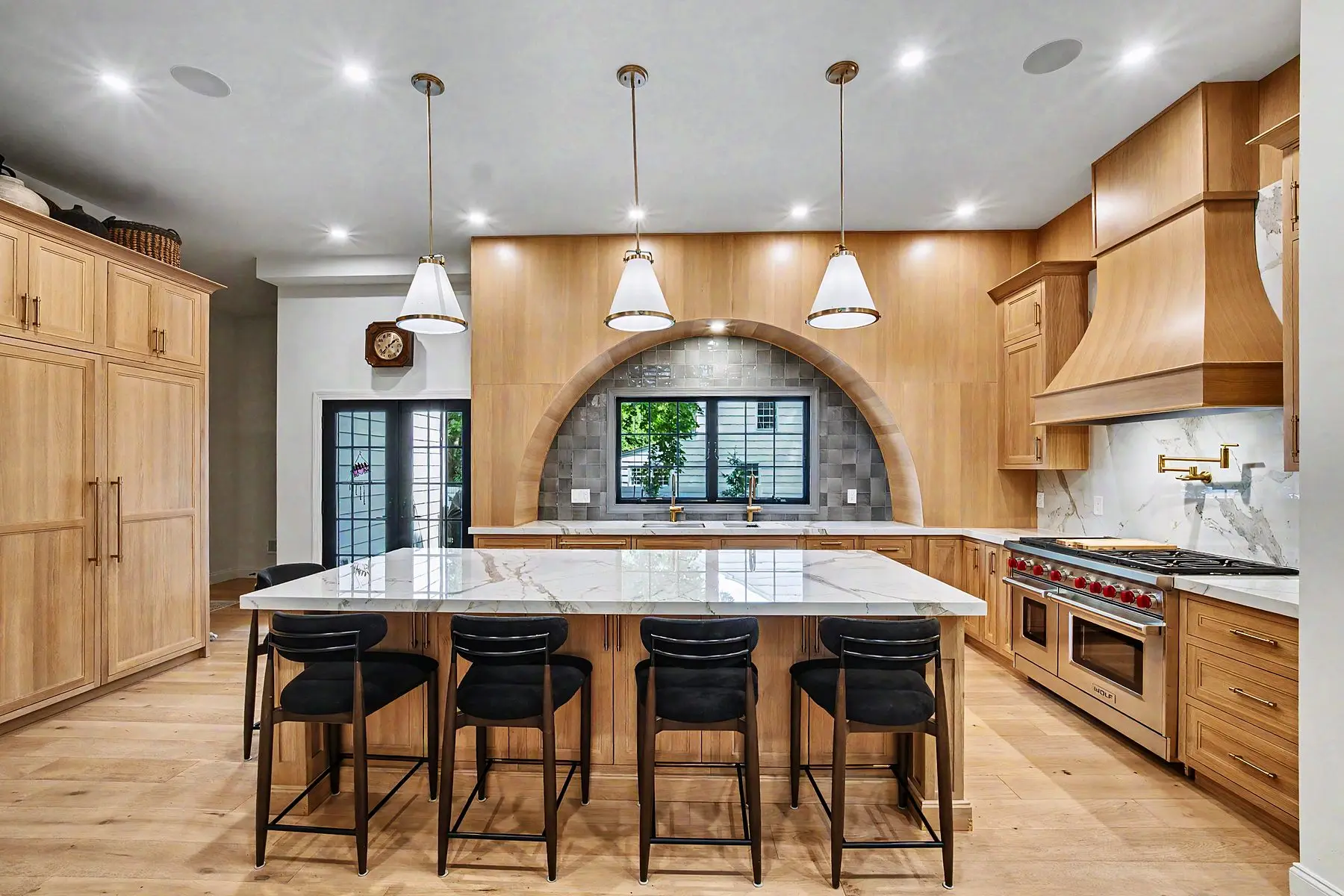
Rift white oak kitchen with arched niche over the sink, Calacatta quartz island and Wolf range — see this project
Why white oak is everywhere right now
Walk through a few recently remodeled homes in Montclair, Ridgewood or Westfield and you will see it: light, straight-grained wood on islands, lower cabinets, hoods and floating shelves. White oak took over from the gray and bright-white kitchens of the last decade because it is warm without being orange, it pairs with almost any paint color, and in the right cut it looks as clean as a slab door and as natural as furniture. In our showrooms, it is the stained finish we are asked about more than all the others combined.
The catch is that the cut changes everything. A plain-sawn white oak door and a rift-cut white oak door can come from the same log and look like two different species.
How a log becomes a board: the three cuts
Picture the end of a log with its growth rings. The angle at which the saw blade crosses those rings decides the grain pattern on the face of the board.
Plain sawn (flat sawn)
The log is sliced straight through, like a loaf of bread. The rings meet the face at a shallow angle, which produces the familiar arched, cathedral grain pattern. It is the fastest way to cut a log and wastes the least wood, so it is the least expensive. It is also the cut that moves the most with humidity.
Quarter sawn
The log is first cut into quarters, then each quarter is sliced so the rings meet the face at a steep angle. The grain runs straight, and in white oak you also get the dramatic ray fleck, the shimmering ribbon-like figure that mission and craftsman furniture is famous for. More stable than plain sawn, and more waste, so more expensive.
Rift sawn
Each board is cut at an angle in between, roughly 30 to 60 degrees to the rings, which gives a tight, straight, linear grain with almost no fleck. It is the most consistent-looking cut and the most wasteful to produce, so it is the most expensive. Rift is what most people mean when they ask for the modern white oak look.
Many manufacturers sell a rift and quartered mix, which uses both cuts and keeps the grain straight while reducing cost and waste.
What each cut looks like on a cabinet door
On a slab door, the cut is the whole design. Rift reads as fine vertical pinstripes and is the choice for minimalist and frameless kitchens. Quarter sawn reads as straight grain with flashes of fleck, which gives a slightly more traditional, handmade feel. Plain sawn reads as broad cathedrals, which can look busy across a long run of doors unless the panels are carefully matched.
On a five-piece shaker door, manufacturers often use solid rift-cut wood for the stiles and rails and a rift-cut veneer for the center panel, so the whole door has straight grain. Ask how the panels are matched. Better lines select and sequence the veneer so adjacent doors look related; lower-cost lines pull panels in whatever order they come.
Stability and movement
Wood moves mostly across the grain, and plain-sawn boards move the most because of how the rings sit. In a New Jersey house that swings from a humid summer to a dry heated winter, that movement shows up as doors that go slightly out of flat and, on painted wood, hairline joint lines. Rift and quarter-sawn boards move less across their width and tend to stay flatter, which is one reason they are preferred for tall doors, wide drawer fronts and inset cabinets, where a warped door will rub the frame.
This is not a reason to avoid plain sawn. It is a reason to buy it from a line that finishes all faces of the door and to keep the house at a reasonably steady humidity. We cover the general topic in our guide to painted vs stained cabinets.
Cost: why rift costs the most
A sawmill gets far fewer rift-cut boards out of a log than plain-sawn boards, and the offcuts are harder to use. That yield difference is the whole story. In the lines we carry, a rift-cut white oak door is usually the most expensive stained option, often roughly a third more than the same door in plain-sawn oak or maple, and sometimes more when the species is in high demand. Quarter sawn sits a little below rift, and a rift and quartered mix sits between the two.
Because of that, a common strategy in our designs is to use rift white oak where it is seen most, such as the island, a run of lowers or a hood, and a painted finish elsewhere. You get the look at a fraction of the cost of a fully white-oak kitchen.
Finishes that work on white oak
The appeal of white oak is its natural color, so most of what we sell is finished in a clear or very light coat. A few notes from the showroom floor:
- Clear and natural: ask whether the topcoat is water-based or solvent-based. Solvent-based clear coats amber slightly over time and warm the wood up; water-based coats stay closer to the raw color.
- Light stains: a thin tan, taupe or gray-brown stain evens out color between boards without hiding the grain. These are the most common choices we see.
- Cerused or limed: a white or light pigment is worked into the open pores and the surface is wiped clean, which makes the grain pop. Works best on quarter sawn and plain sawn, where the pores are more open.
- Wire-brushed: the soft grain is brushed out for texture you can feel. Popular on islands and in casual kitchens.
What we avoid is anything with an orange or honey cast, which drags white oak back toward the golden oak kitchens of the 1980s that we are so often replacing.
Red oak is not white oak
Most of the oak in older New Jersey kitchens is red oak, and homeowners sometimes assume white oak will look the same. It will not. Red oak has larger, more open pores, a pink to reddish cast and a coarser, busier grain. White oak is tighter, tan to gray-brown, and much more flecked when quarter sawn. If you are matching new cabinets to existing oak floors, bring a photo or a scrap of flooring; a red oak floor pairs well with white oak cabinets as long as the floor is finished in a neutral tone rather than a red stain.
Which doors and lines offer each cut
Availability follows the cabinet level. In-stock lines typically offer a white oak look in a limited set of door styles and finishes, often as a flat-cut or veneered panel, and sometimes as a textured laminate that imitates rift oak very convincingly. Semi-custom lines are where real rift-cut white oak becomes widely available: Shiloh offers rift white oak in several of its door styles and finishes, and its frameless sister line Eclipse offers rift white oak slab and shaker doors that are a natural fit for modern kitchens. Several of our other semi-custom lines have added white oak options recently, so ask us for current door samples.
Custom lines let you specify the cut rather than choose from a menu. Great Northern, Plain & Fancy and Crystal will build in rift, quarter sawn, plain sawn or a mix, in any door style, with sequenced veneers across a run and matching panels for the island and the hood.
Pairing white oak with paint
White oak is rarely the only finish in the kitchens we design. The pairings we see most are a warm white perimeter with a rift oak island, sage or olive green uppers over oak lowers, and black or charcoal paint with oak for a more dramatic look. The rule is to keep the undertones in the same family and to let the countertop bridge the two. Our guide to two-tone kitchens goes through the combinations in detail, and a free 3D design lets you see your own kitchen with oak in different places before you decide where to spend.
Bottom line
If you want the clean, modern white oak look, ask for rift cut and expect to pay for it. If you like a little more character and a slightly lower price, quarter sawn or a rift and quartered mix is the sweet spot. Plain sawn is the budget choice and still a good one on a shaker door with well-matched panels. Bring a photo of your floors to Union, Paramus or Rochelle Park and we will put the three cuts next to each other under real light.
Questions on this topic
Is rift-cut white oak worth the extra cost?
Does white oak yellow over time?
Can I get white oak in an in-stock cabinet line?
Will white oak cabinets go out of style?
Related guides

Cabinets 101: How Kitchen Cabinets Are Built and What to Look For
Boxes, doors, drawers, finishes and hardware explained in plain language, so you can compare kitchen cabinet lines at any New Jersey showroom.
Read the guide
Inset vs Framed (Overlay) vs Frameless Cabinets: Construction, Look, Cost and Storage
Inset, full-overlay framed and frameless cabinets compared on construction, look, storage and cost, with the lines that offer each at our NJ showrooms.
Read the guide
2027 Kitchen Trends We're Seeing in New Jersey Homes
The kitchen colors, woods, islands, hardware, counters and layouts New Jersey homeowners are choosing for 2027, from the floor of our three showrooms.
Read the guideTurn the reading into a plan.
Send this and a designer will call within one business day to arrange a showroom visit or a measurement. No obligation.
Or send the details and we'll call you