
2027 Kitchen Trends We're Seeing in New Jersey Homes
We do not read trend reports to find out what is popular; we watch what people point at in our showrooms and what we install in their homes. This is what New Jersey homeowners are choosing as they plan kitchens for 2027, from paint colors to the shape of the island, with a note on what is quietly fading.
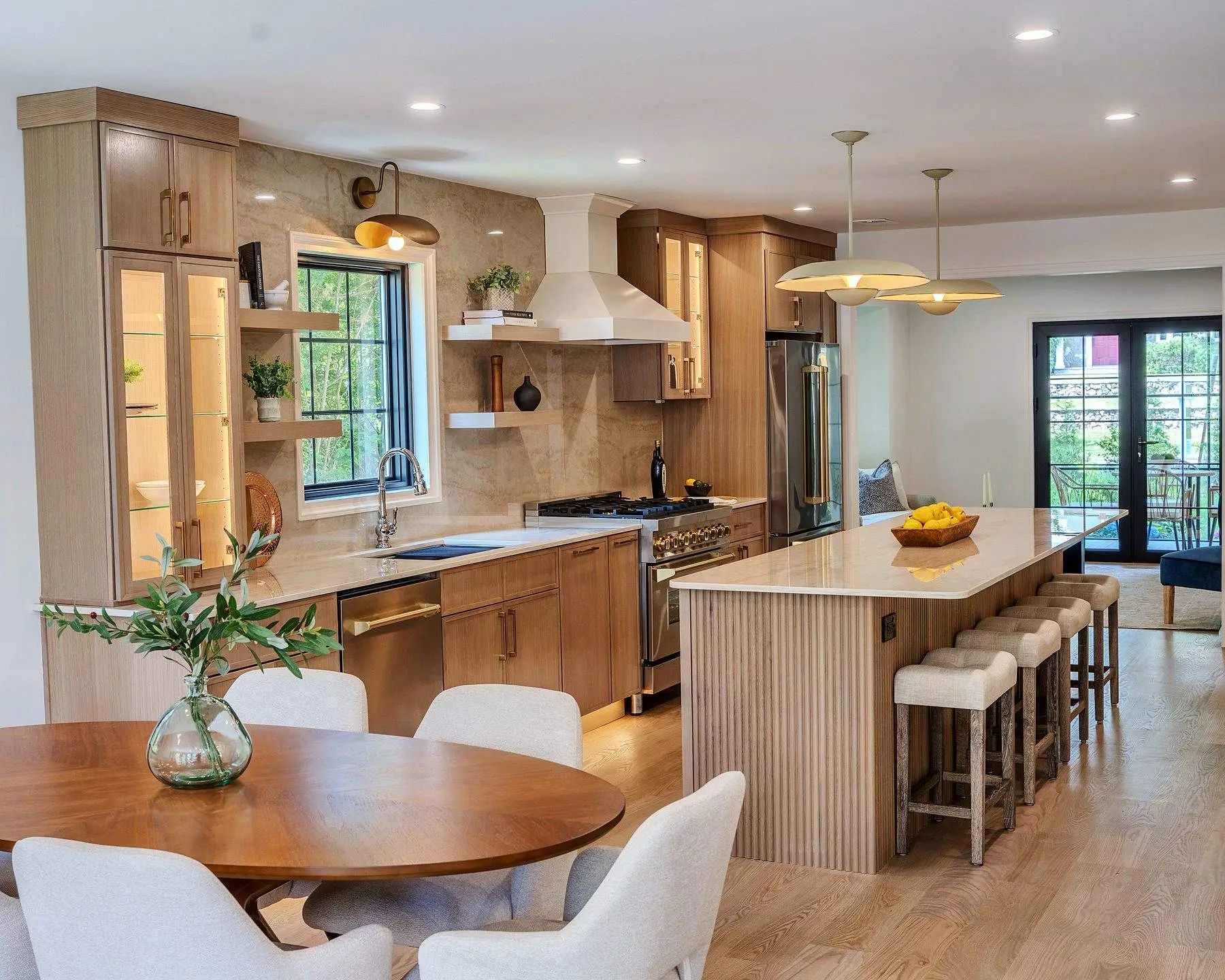
Desert Oak slab kitchen with fluted island and quartzite backsplash — see this project
Color: warm whites, deep greens and a return of brown
White is still the most common perimeter color we sell, but it is a different white than five years ago. Bright, cool whites have given way to warm whites, creams and soft off-whites that look good next to wood and natural stone. The accent colors have moved from gray toward nature: sage, olive and forest green on islands and lowers, slate and navy blue for a more formal look, and warm neutrals like mushroom, greige and clay for people who want color without commitment.
The newest thing we are seeing is brown, not as a dark stain but as a painted or stained chocolate tone on an island or a run of lowers, paired with a cream perimeter. Black remains popular for a single feature run. What we rarely see anymore is an all-gray kitchen.
Wood: white oak first, walnut second
Natural wood is back in nearly every kitchen we design, usually as one element rather than the whole room. Rift-cut white oak leads by a wide margin, in a clear or barely-tinted finish, on islands, lower cabinets, hoods, open shelves and tall pantry walls. Walnut is the second choice, for people who want something darker and richer. Both are being chosen in straight-grain cuts and light finishes; the heavy, glossy cherry and espresso kitchens of the 2000s are the ones we are now replacing. Our guide to white oak cuts explains why the cut matters so much to the look.
Two-tone kitchens and the island as furniture
The single most common request in our showrooms is a two-tone kitchen: a painted perimeter with a wood or colored island, or painted uppers over wood lowers. The island is increasingly designed to read as a piece of furniture, with a different color, furniture-style legs or a thicker countertop, open shelving at the ends and a waterfall edge on one side. We are also seeing more islands with a stepped-up or stepped-down section, so that the seating side feels like a table. Our guide to pairing colors in a two-tone kitchen covers the combinations that work.
Doors: slim shaker, slab and fluted accents
The shaker door remains the backbone of New Jersey kitchens, but it is getting thinner. Slim or skinny shaker, with narrower stiles and rails, gives a lighter, more modern look while keeping the shaker frame people are comfortable with. Slab doors have grown with the rise of frameless cabinets and white oak, since a flat door shows off the grain. Fluted or reeded panels are appearing as accents on island ends, bar fronts and hood surrounds, rarely across a whole kitchen.
Raised-panel doors with arched tops are almost never requested now, though a simple square raised panel still suits a traditional colonial. Our comparison of shaker, slab and raised panel doors goes through the options.
Hardware and metals
Brushed and satin brass have settled in as the leading hardware finish, usually in a warm, unlacquered or lightly aged tone rather than a bright polish. Matte black is second, and polished nickel has come back for traditional and inset kitchens. Mixed metals are no longer unusual: a brass faucet with black pulls, or nickel on the perimeter and brass on the island.
Shapes are simple: long bar pulls on drawers, small knobs or cup pulls on doors, and, in frameless kitchens, no hardware at all, using integrated channel pulls or push-to-open hardware. Pulls are getting longer, with some drawer fronts carrying a single pull nearly the width of the drawer.
Countertops and backsplashes
Quartz is still the surface most of our customers choose, but the patterns have warmed up. Instead of stark white with gray veins, people are asking for creamy backgrounds with taupe, gold or soft brown veining that pairs with white oak and warm paint. Honed and matte finishes are gaining on polished. Porcelain and sintered surfaces, such as Dekton, are chosen for their heat resistance and for very large, book-matched slab looks, and natural quartzite is the choice for people who want real stone with a light, veined look.
Backsplashes
Backsplashes are going full height: the countertop material run up the wall to the hood or to the uppers, or a single slab behind the range with tile elsewhere. Where tile is used, we see handmade-look zellige and glazed ceramic in soft colors, vertical stacks instead of running bond, and larger formats. Browse our countertop options and tile collections to see the materials we are describing.
Lighting: layered and warm
The kitchens we install today have more light sources and softer light than the ones they replace. Under-cabinet LED strips are standard, toe-kick lighting is common in islands and tall cabinets, and interior cabinet lighting shows up behind glass doors. Pendants over the island are getting larger and fewer: two big fixtures instead of three small ones, or a single linear fixture. The color temperature has moved warmer, which flatters wood and warm whites; the cool blue-white LEDs of a few years ago make a cream kitchen look dingy.
Layouts: bigger islands, hidden storage, fewer uppers
Three layout trends stand out in New Jersey homes. First, islands are growing, as homeowners remove walls between the kitchen and dining room in colonials and splits to make room for seating for four or more. Our island size and seating guide covers the clearances that make that work.
Second, storage is going behind doors. Walk-in pantries, tall pantry walls, appliance garages and coffee stations with pocket doors keep counters clear. Third, uppers are shrinking on at least one wall, replaced by a window, a full-height backsplash or a pair of floating wood shelves, with the storage shifted to tall cabinets and deeper drawers. Panel-ready refrigerators and dishwashers, hidden behind cabinet doors, round out the clean look.
What this looks like in a typical New Jersey house
In a 1960s split-level, that usually means taking down the wall to the dining area and running an island where the wall stood, with a tall pantry wall replacing the old broom closet. In a center-hall colonial, it more often means keeping the kitchen's footprint, removing the uppers on the window wall, and adding a butler's-pantry-style run with a coffee station between the kitchen and dining room. In a cape or a galley, the trend shows up as frameless cabinets, deep drawers and one wall of tall storage, because there is no room to add an island at all.
What we see less of
Trends are easier to spot in reverse. The requests that have mostly disappeared from our showrooms are all-gray kitchens, glossy espresso or dark cherry stains, cathedral-arch raised-panel doors, busy speckled granite, small-format glass mosaic backsplashes, and oil-rubbed bronze hardware. None of these is wrong, and we still supply them for homeowners matching an existing style. They are simply not what people are choosing when they start fresh. You can see what they are choosing in our recent projects.
Bottom line
If you are planning a kitchen for 2027 and want it to feel current for a long time, the safe path is a warm white or cream perimeter, natural white oak or a deep green or blue on the island, slim shaker or slab doors, warm brass or black hardware, a creamy veined quartz or quartzite counter run up the wall as a backsplash, and layered warm lighting. Come to Union, Paramus or Rochelle Park with a few photos you like, and we will design it in 3D for free so you can see how these pieces look together in your own room.
Questions on this topic
Is white still a safe choice for kitchen cabinets?
Are gray kitchens out of style?
Is brass hardware going to date quickly?
What is the most popular countertop right now?
Related guides

Small Kitchen Layout Ideas for New Jersey Homes: Galleys, Capes, Splits and Pre-War Colonials
Layout ideas for galley, Cape Cod, split-level and pre-war kitchens common across New Jersey, with the cabinet choices that make a small kitchen work.
Read the guide
Two-Tone Kitchens: How to Pair Cabinet Colors (and Wood with Paint)
How to pair two cabinet colors or a wood with a paint: island vs perimeter, upper vs lower, undertones, hardware and the combinations we see work in NJ.
Read the guide
Cabinets 101: How Kitchen Cabinets Are Built and What to Look For
Boxes, doors, drawers, finishes and hardware explained in plain language, so you can compare kitchen cabinet lines at any New Jersey showroom.
Read the guideTurn the reading into a plan.
Send this and a designer will call within one business day to arrange a showroom visit or a measurement. No obligation.
Or send the details and we'll call you