
Shaker vs Slab vs Raised Panel Cabinet Doors: Which Style Fits Your Kitchen?
The door is the part of a cabinet you see, so the door style decides the look of the kitchen more than any other choice. Nearly every door on the market is a version of three designs: shaker, slab or raised panel. Here is how each is built, how it lives day to day, what it costs and which houses it suits, with the variations you will run into on a showroom floor.
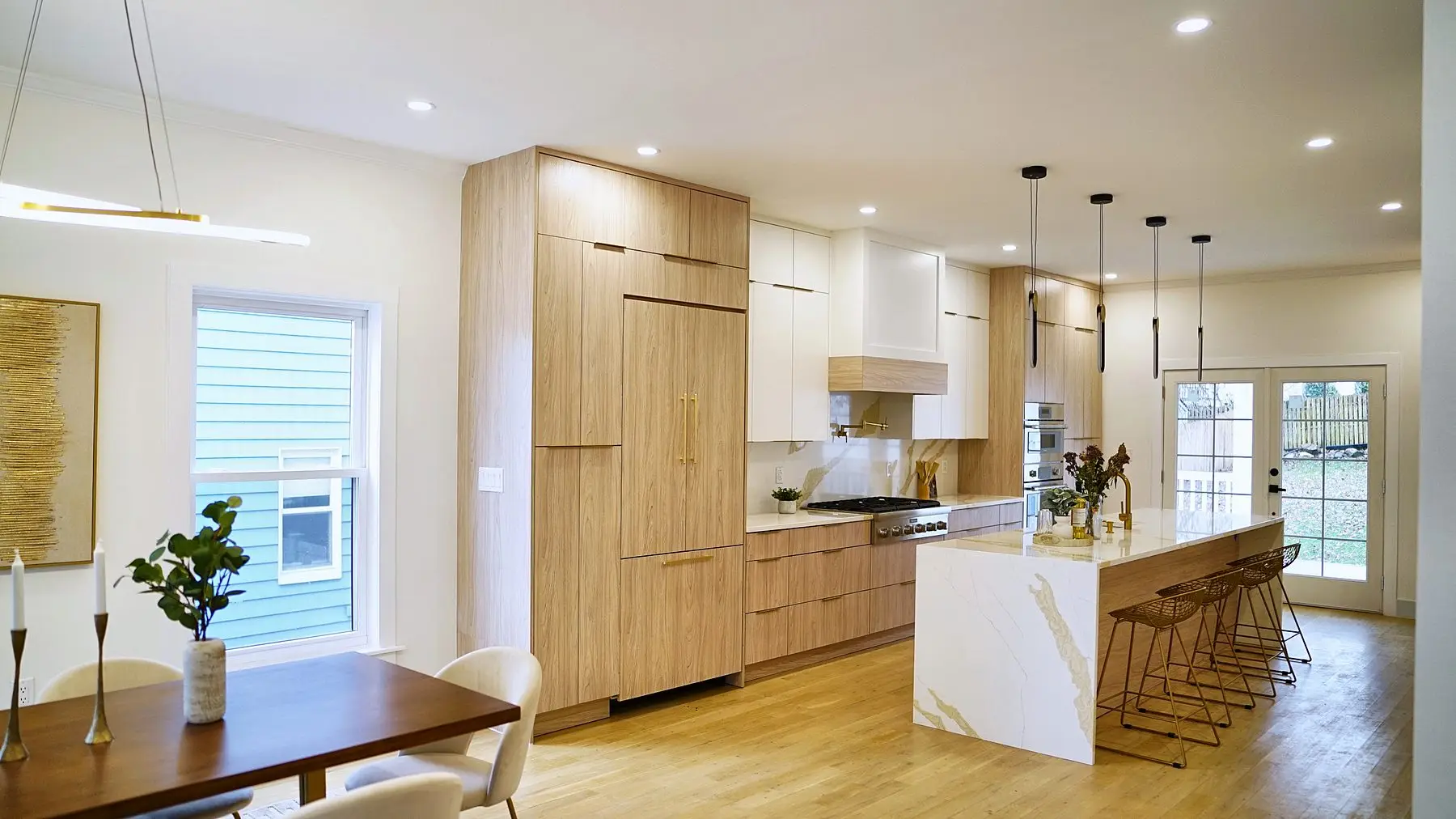
Matte white and rift oak slab kitchen with Calacatta waterfall island — see this project
How a cabinet door is built: five-piece vs slab
Shaker and raised panel doors are five-piece doors: two vertical stiles, two horizontal rails and a center panel that floats in a groove so it can expand and contract. The difference between the two is the panel: flat and recessed for shaker, raised and profiled for raised panel. A slab door is a single flat piece with no frame at all.
The construction matters for finish and durability. A five-piece door in solid wood will show fine joint lines under paint as the wood moves with New Jersey's humid summers and dry winters; manufacturers reduce this with MDF center panels or all-MDF doors for paint. A slab door in MDF has no joints to open, which is part of why it is the standard in painted modern kitchens. Our Cabinets 101 guide goes deeper into what doors are made of.
Shaker doors
The shaker is a five-piece door with a flat center panel and square, unadorned frame edges. It is simple, it suits almost any house, and it is the door we sell more than all others combined. It takes paint and stain equally well and bridges traditional and modern.
Variations
- Standard shaker: stiles and rails around two and a quarter inches wide, the proportion most people picture.
- Slim or skinny shaker: narrower frames, often around an inch and a half, for a lighter, more contemporary look. One of the most requested variations in our showrooms right now.
- Beaded shaker: a small bead routed where the frame meets the panel, for a softer, more traditional detail.
- Shaker with a thicker or stepped panel: a slightly more substantial feel, often chosen for inset kitchens.
- Mission or craftsman: wider frames, sometimes with a wider bottom rail, for a heavier, early-twentieth-century look.
Slab doors
A slab door is one flat surface. In painted kitchens it is usually MDF, which paints perfectly smooth; in wood kitchens it is a veneer over an engineered core, chosen so the grain can be matched across a run; in frameless European lines it can be laminate, textured melamine, acrylic or high-gloss. Slab doors are the natural partner of frameless cabinets, where the doors nearly touch and the whole run reads as a plane, and they are the best way to show off rift-cut white oak or walnut grain.
Slab is the easiest door to clean and the one that shows fingerprints most, especially in dark colors and high gloss. Matte and textured finishes hide them well. Handle choice matters more on a slab than on any other door; long bar pulls, integrated channel pulls or push-to-open hardware all change the look. Our frameless Eclipse line is where most of our slab-door kitchens come from.
Raised panel doors
A raised panel door is a five-piece door whose center panel is thicker and shaped at the edges so it stands proud of the frame, with a profile routed around the frame as well. It is the traditional door of the American kitchen, and in older New Jersey colonials it is often what is being replaced.
Variations
- Square raised panel: a simple, clean raised panel that still suits a formal or traditional house.
- Cathedral or arched top: the arched upper rail of the 1980s and 1990s kitchen, now rarely requested.
- Mitered raised panel: the frame corners are mitered rather than butt-jointed, which allows heavier, more ornate profiles and is common in high-end traditional lines.
- Applied molding: a flat or raised door with a separate molding applied inside the frame, for a layered, furniture-like look.
Raised panel doors are heavier, collect a little more dust in their profiles and cost more to build in solid wood, but in the right house, a center-hall colonial with crown molding and wainscoting, they look correct in a way a slab never will.
Other styles worth knowing
- Flat panel (recessed panel): a shaker with a profiled inside edge instead of a square one. A step between shaker and raised panel.
- V-groove and beadboard: a shaker with vertical grooves in the panel, for cottage and farmhouse kitchens.
- Fluted and reeded: vertical ribs across the whole face, used as an accent on island ends and hoods rather than across a kitchen.
- Glass and mullion doors: any frame style with a glass panel, with or without dividers, for display uppers.
- Louvered: slats instead of a panel, rare now but occasionally used in coastal homes.
Cleaning and daily life
Slab is the easiest to wipe down and the quickest to show fingerprints. Shaker has one ledge at the bottom rail where crumbs and dust settle, and a square inside corner that takes a cloth corner to clean; slim shaker has less of both. Raised panel has the most profile to collect dust and grease, which matters most near the range. In practice, none of them is hard to keep clean with a damp cloth and a little dish soap, and the finish matters more than the style: a factory conversion-varnish finish on any door wipes clean far better than a site-painted one.
Cost differences
Within most of the lines we carry, a painted shaker in maple with an MDF panel is the baseline door and the best value, and a square raised panel in the same material is close to it. A painted MDF slab is often the same or slightly less. Costs climb with solid-wood slabs in rift oak or walnut, mitered raised panels with heavy profiles, applied moldings, beaded details, and any door that needs hand work. In in-stock lines like Forevermark and Fabuwood, the door style is part of the fixed price and the choice is mostly about look.
Matching the door to your house
We let the house vote. A pre-war colonial or Tudor in Montclair or Westfield suits shaker or a simple raised panel, often inset, in a painted finish. A mid-century split-level or ranch takes shaker or slab equally well, and slab with white oak looks especially right in a ranch. A new or modern house wants slab, slim shaker or a mix, usually frameless. A cape or a farmhouse is happiest with shaker, beaded shaker or V-groove. These are starting points, not rules, and plenty of New Jersey homeowners put a clean slim shaker in a hundred-year-old house with excellent results. The question to ask is whether the door will look like it belongs in five years; our note on kitchen trends in New Jersey covers which styles are gaining and fading.
Which lines offer which doors
Shaker is available in every line we carry, from in-stock to custom, and slim shaker is now in most of them. Slab doors appear in our frameless Eclipse line, across the semi-custom lines in painted and wood-veneer versions, and in the in-stock lines in a smaller set of colors. Square raised panel doors are in nearly every line; mitered, applied-molding and ornate profiles are semi-custom and custom territory. Beaded inset, mission and fully custom profiles are what Shiloh, Great Northern, Plain & Fancy and Crystal are for. Door style and box construction are separate decisions, which our guide to inset, framed and frameless cabinets explains.
Bottom line
If you are unsure, choose shaker; it is the door that suits the most houses, takes any finish and costs the least. Choose slim shaker or slab if the kitchen is modern or you want to show off a wood grain, and pair slab with frameless cabinets. Choose a square raised panel for a formal, traditional house and skip the arched tops. Then come see the three side by side at any of our showrooms, where we will put your color on each of them and draw your kitchen in 3D for free with the door you like.
Questions on this topic
Is shaker going out of style?
Are slab doors cheaper than shaker?
Can I mix door styles in one kitchen?
Do raised panel doors make a kitchen look dated?
Related guides

Cabinets 101: How Kitchen Cabinets Are Built and What to Look For
Boxes, doors, drawers, finishes and hardware explained in plain language, so you can compare kitchen cabinet lines at any New Jersey showroom.
Read the guide
Inset vs Framed (Overlay) vs Frameless Cabinets: Construction, Look, Cost and Storage
Inset, full-overlay framed and frameless cabinets compared on construction, look, storage and cost, with the lines that offer each at our NJ showrooms.
Read the guide
2027 Kitchen Trends We're Seeing in New Jersey Homes
The kitchen colors, woods, islands, hardware, counters and layouts New Jersey homeowners are choosing for 2027, from the floor of our three showrooms.
Read the guideTurn the reading into a plan.
Send this and a designer will call within one business day to arrange a showroom visit or a measurement. No obligation.
Or send the details and we'll call you