
Stock vs Semi-Custom vs Custom Cabinets: How to Choose the Right Level
Stock, semi-custom and custom are the three levels every showroom talks about, and the names are misleading. Stock does not mean cheap, custom does not mean better built, and semi-custom covers an enormous range. Here is what each level actually means in the lines we carry, how long each takes, and how we help homeowners decide which one their kitchen needs.
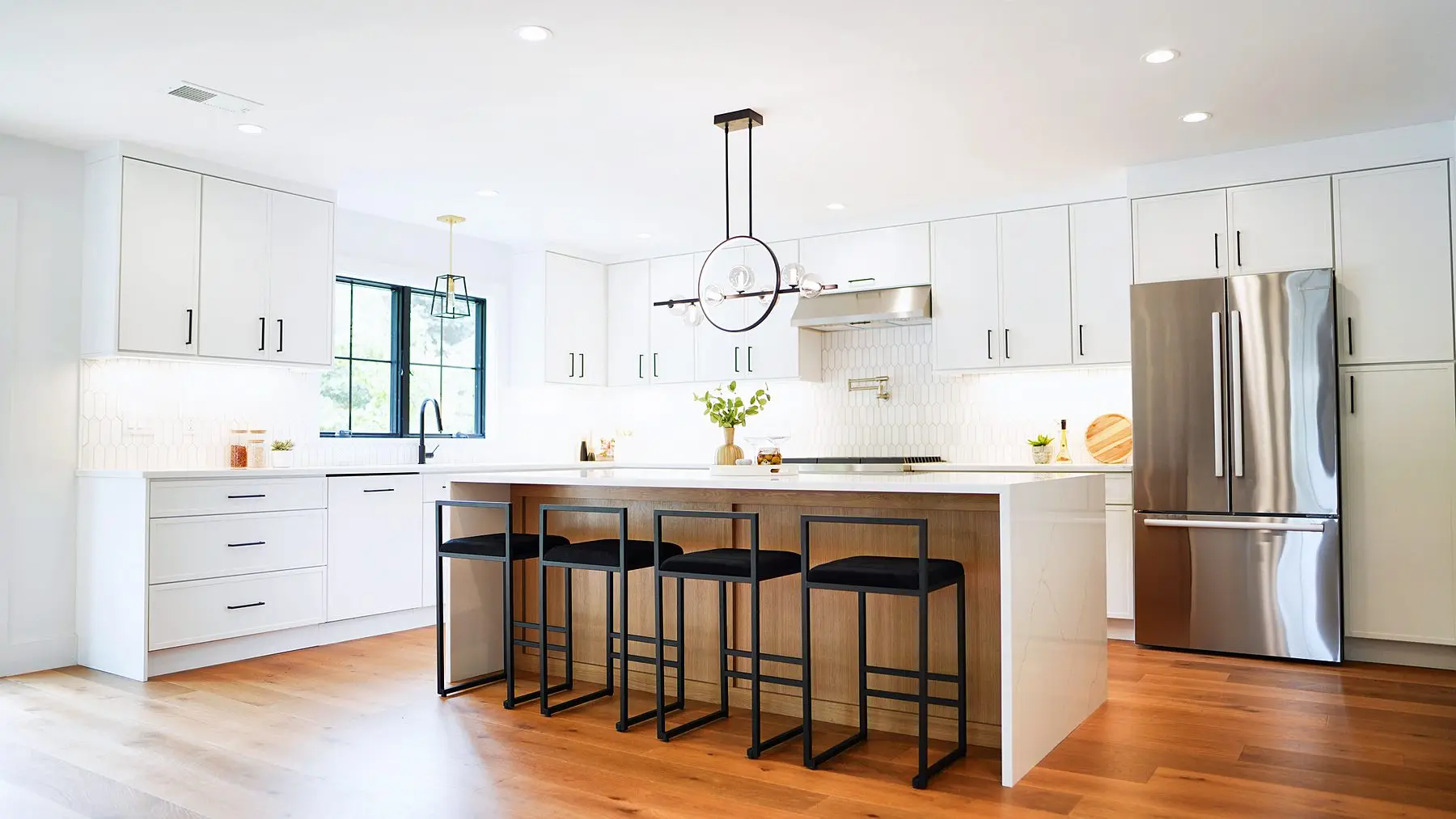
Petit White kitchen with Petit Oak island and waterfall quartz — see this project
What stock (in-stock) really means
A stock line is a cabinet program with a fixed catalog: a set of door styles, a handful of finishes and the standard sizes, built in volume and warehoused so they can ship within days. The quality baseline is often better than people expect. Our in-stock lines, Forevermark, FGM, J&K, 21st Century, WoodConcept and the Signature colors from Fabuwood, all come with plywood boxes, dovetail drawers and soft-close hardware as standard, which was a semi-custom feature not long ago. Three of them, FGM in Linden, 21st Century in Moorestown and WoodConcept in South Plainfield, are based right here in New Jersey, which keeps delivery short.
What you give up is flexibility. Sizes come in 3-inch increments with no modifications, the palette is small, and accessories are limited to the catalog. For a standard kitchen in a standard color, that is a trade worth making.
What semi-custom means
Semi-custom lines start from a catalog but let you change it. Dozens of paint colors and stains across several species, door styles in the hundreds, cabinets that can be made shorter, deeper, taller or wider by the inch, and a long accessory list. Each cabinet is built to order after you place the order, which is why the lead time is longer. Our semi-custom lines are Fabuwood Allure, NOMA, Kith and Eudora, St. Martin, Shiloh and the frameless Eclipse.
The range inside this level is wide. At one end, a semi-custom line with a few modifications prices close to in-stock. At the other, a fully modified, specialty-finished semi-custom kitchen approaches custom. Shiloh in particular bridges the levels, because it offers inset construction, a custom feature, at a semi-custom price.
What custom means
Custom cabinetry is built from drawings, not from a catalog. Any dimension, any door, inset or overlay or frameless, any species, a color matched to any paint chip, and the details that make a kitchen look like built-in furniture: beaded face frames, furniture toe kicks, turned posts, curved pieces, integrated range hoods. Our custom lines are Great Northern and Shiloh inset at Level III, and Plain & Fancy and Crystal at the top, where there is essentially no catalog boundary.
The construction is not fundamentally different from a good semi-custom line; it is the same plywood, dovetails and conversion varnish. What you pay for is freedom and finishing, and the people in the factory who spend more time on each piece.
Lead times at each level
Timing is often what decides the level, so here is what we generally see. These vary by manufacturer, by season and by how busy the factories are, so treat them as ranges rather than promises.
- In-stock: days to a couple of weeks from order to delivery, because the cabinets already exist. Some lines ship assembled; others arrive flat and are assembled by us.
- Semi-custom: typically a month or two from order to delivery, longer for specialty finishes and inset, and longer in the busy spring and early-fall seasons.
- Custom: two to three months is common, and more for complex kitchens or during busy periods.
Lead time starts when the order is placed and the design is final, not when you first visit. Changes after the order restart the clock, which is why we take the time to finish the design before ordering.
Flexibility: sizes, depths and finishes
Flexibility is the real product difference between the levels, and it matters more in some houses than others. A square kitchen with eight-foot ceilings in a 1990s colonial can be filled beautifully with in-stock sizes. A pre-war kitchen with a chimney bump-out, a window off center and a nine-and-a-half-foot ceiling needs cabinets made to fit, or it needs fillers and compromises that show. Semi-custom depth and height changes solve most of these problems; custom solves all of them. We make this call during the free 3D design, when we have measured the room and know where the odd dimensions are.
Finish flexibility
In-stock lines offer a few whites, grays and stains. Semi-custom opens up greens, blues and warm neutrals, several species including rift-cut white oak, and textured finishes. Custom will match anything. If the color you want exists in an in-stock line, that alone can save a large share of the budget.
Is custom better built?
Not necessarily, and this surprises people. The baseline construction we insist on, plywood boxes, dovetail drawers, soft-close undermount glides and a factory conversion-varnish finish, is present in every line we carry, including the in-stock ones. What changes as you move up is the number of options, the thickness and detailing of some components, the sophistication of the finishing, and the amount of hand work. A custom inset kitchen is a more refined object than an in-stock full-overlay kitchen, but both will still be working in twenty-five years if they are installed well and kept dry.
When stock is the smart choice
We recommend in-stock cabinets more often than people expect, and not only on tight budgets. They are the right call when the layout is fairly standard, when a white, gray or standard stain suits the house, when you need the kitchen done quickly (a sale, a move, a rental turnover, water damage), or when the money is better spent elsewhere, such as on a better countertop, a wall removal or a full-height backsplash. Many of the kitchens in our project gallery are in-stock lines, and most people cannot tell which ones.
When to step up to semi-custom
Step up when the room has dimensions the catalog cannot fill, when you want a specific color or wood, when you want deeper drawers or a tall pantry wall sized to the ceiling, or when the accessory list matters: a mixer lift, a built-in spice pull-out, a corner solution, a lift-up door over the coffee station. Step up to Shiloh when you want inset at a sensible price. Step up to Eclipse when you want a frameless, modern kitchen with slab doors and maximum drawer space. Our guide to what drives cabinet cost in New Jersey explains how modifications and accessories affect the number at this level.
When custom is worth it
Custom earns its cost when the kitchen is part of a larger architectural project, when the home has original millwork that new cabinets should match, when the design calls for pieces that do not exist in a catalog (a curved island end, a hood built as cabinetry, a hutch with turned legs), or when the finish needs to be matched exactly to something else in the house. It is also the practical choice in the kind of old, irregular rooms common in towns like Montclair, Maplewood and Westfield, where fitting cabinets to the walls rather than the walls to the cabinets is the whole job. Our cabinet pricing guide sets out how the levels compare before you decide.
Bottom line
Start with the room and the look, not the level. If a standard layout and a standard color fit, in-stock cabinets are a genuinely good product and the savings can fund a better countertop or a wall removal. If the room is irregular or the color is specific, semi-custom solves nearly everything at a moderate premium. If the kitchen needs to be built to the house rather than chosen from a catalog, custom is worth it. We carry all three levels in every showroom, and we will price your kitchen at two levels, line by line, so you can see what the difference really buys.
Questions on this topic
Are stock cabinets lower quality than semi-custom?
How long do semi-custom cabinets take?
Can I mix levels in one kitchen?
Which level is best for resale?
Related guides

Cabinets 101: How Kitchen Cabinets Are Built and What to Look For
Boxes, doors, drawers, finishes and hardware explained in plain language, so you can compare kitchen cabinet lines at any New Jersey showroom.
Read the guide
Inset vs Framed (Overlay) vs Frameless Cabinets: Construction, Look, Cost and Storage
Inset, full-overlay framed and frameless cabinets compared on construction, look, storage and cost, with the lines that offer each at our NJ showrooms.
Read the guide
2027 Kitchen Trends We're Seeing in New Jersey Homes
The kitchen colors, woods, islands, hardware, counters and layouts New Jersey homeowners are choosing for 2027, from the floor of our three showrooms.
Read the guideTurn the reading into a plan.
Send this and a designer will call within one business day to arrange a showroom visit or a measurement. No obligation.
Or send the details and we'll call you