
How Much Do Kitchen Cabinets Cost in New Jersey? What Really Drives the Price
Cabinets are usually the largest single line on a kitchen remodel, and the price can swing by several multiples for kitchens that look alike in a photo. This article is not a price list; our pricing guide covers that for each level. It is an explanation of what moves the number, so that when you compare two quotes you know what you are actually comparing.
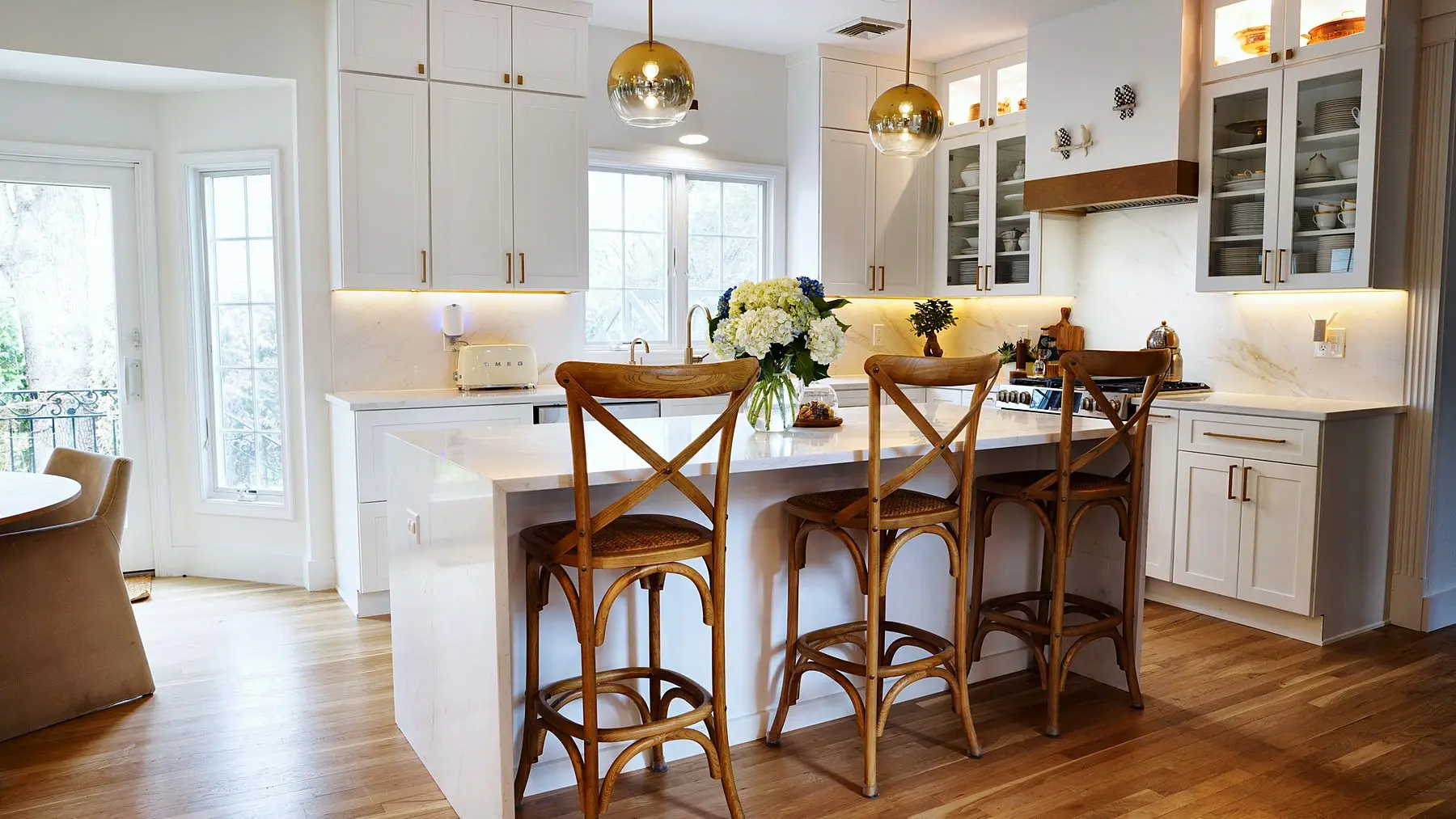
Galaxy Dove kitchen with waterfall island and cross-back stools — see this project
The levels: in-stock, semi-custom, custom and top custom
The biggest single factor is the level of the line, because it sets the starting point for everything else.
- Level I, in stock: Forevermark, FGM, J&K, 21st Century, WoodConcept and Fabuwood's Signature colors. Fixed sizes, a tight palette, fast delivery and the lowest price per cabinet.
- Level II, semi-custom: Fabuwood Allure, NOMA, Kith and Eudora, St. Martin, Shiloh and frameless Eclipse. Many more finishes, modifications to size and depth, and a deep accessory catalog. For a similar kitchen, expect roughly one and a half to two times the in-stock price.
- Level III, custom and inset: Shiloh inset and Great Northern. Any dimension, inset construction, more finishes and details. Often double to triple in-stock.
- Top tier: Plain & Fancy and Crystal, where nearly anything can be built and finished to order. Several times in-stock, depending on what you ask for.
Those multiples are rough, and they overlap. A heavily accessorized in-stock kitchen can cost more than a simple semi-custom one. Our guide to choosing between stock, semi-custom and custom explains what each level is actually buying you.
The box and the door
Within a level, construction choices move the price in predictable ways. Plywood boxes cost a little more than furniture board where both are offered. A five-piece shaker door in paint-grade maple with an MDF panel is the baseline door in most lines; a solid-wood raised panel, a mitered door with applied molding or a slab in a real wood veneer costs more. Inset construction adds a premium over full overlay, typically a fifth to a third more, because every door is individually fitted. Frameless boxes are priced close to full-overlay framed within comparable lines.
If you want to understand the parts behind these choices, our Cabinets 101 guide walks through boxes, doors, drawers and hardware.
Finish: stain, paint and specialty
In in-stock lines, every finish costs the same. In semi-custom and custom lines, a painted finish usually carries an upcharge over a standard stain, and a custom color match adds more. Glazes, distressing, wire-brushing, cerused finishes and high-gloss or metallic finishes each add a step in the factory and a step in the price. Species matters too: maple and oak are the baseline, rift-cut white oak sits meaningfully above them, and walnut is usually the most expensive wood in a line.
The least expensive way to get a premium finish is to use it in a small area: a stained white oak island in an otherwise painted kitchen, for example, costs a fraction of a fully white oak kitchen.
Size and layout: it is not just linear feet
Two kitchens with the same wall length can differ a lot in price depending on what fills that length.
- Tall cabinets (pantries, oven cabinets, refrigerator surrounds) cost several times a base cabinet of the same width.
- Drawer bases cost noticeably more than door bases with a shelf, because of the extra drawer boxes and glides. A kitchen built on drawers is more useful and more expensive.
- Wall cabinets get more expensive as they get taller; a 42-inch upper to the ceiling costs more than a 30-inch one with a soffit.
- Islands need finished backs, end panels and often a seating overhang support, which are extra line items beyond the cabinets themselves.
- Corners are expensive to solve well. A blind corner with a pull-out mechanism or a lazy susan costs more than the plain corner cabinet it replaces.
A good designer uses standard widths to fill the run and keeps fillers to a minimum, because every filler is money that is not buying storage.
Modifications and custom sizes
Modifications are where semi-custom pricing can surprise people. Reducing the depth of a cabinet, increasing its height, adding a finished side, changing a toe-kick height or widening a cabinet to a non-standard dimension each carries a charge, and a kitchen with many modifications can approach custom pricing without the custom flexibility. Custom lines fold most of this into the base price, which is part of why they can make sense for odd rooms. In in-stock lines, modifications are generally not available at all; we solve the problem with fillers, panels and careful planning instead.
Accessories and organizers
The accessory list is where a quote grows quietly. Trash and recycling pull-outs, roll-out trays, spice pull-outs, tray dividers, drawer organizers, lift-up doors, mixer lifts, corner mechanisms and pantry systems each add to the price, and together they can add a meaningful share to a semi-custom kitchen. We think most of them are worth it: a trash pull-out and a few roll-out shelves get used every day for twenty years. But we list each one separately so you can decide which ones earn their place. Some of these can also be added later with aftermarket hardware, which is a reasonable way to phase a budget.
Moldings, panels and the finishing line items
Crown molding, light rail under the uppers, toe-kick, scribe molding, decorative end panels, refrigerator and dishwasher panels, island back panels, corbels, posts and glass doors are the items that turn a set of boxes into a finished kitchen, and they are often a bigger share of the quote than people expect. A stacked crown to a nine-foot ceiling, for example, can cost as much as a cabinet. Panel-ready appliances need matching panels that are priced per panel. None of these are hidden on a line-by-line quote, which is one reason we insist on quoting that way.
Installation, delivery and everything that is not cabinets
Cabinet installation is priced on the job, based on the number of cabinets, the level (inset and frameless take longer), the condition of the walls and floors, and details like crown and panels. Because we install with our own crews, that number is on our quote rather than on a separate contractor's. The rest of a remodel sits outside the cabinet number entirely: demolition and disposal, plumbing and electrical, flooring, countertops, backsplash tile, appliances and permits. Countertops in particular are a separate decision with their own range; see our countertop options and our guide to the kitchen remodel timeline in New Jersey for how the pieces sequence.
How to compare two quotes fairly
When homeowners bring us a competing quote, the first thing we do is make it comparable. Check these items:
- Is the cabinet level the same? An in-stock quote and a semi-custom quote are not competing; they are different products.
- Are the boxes plywood or furniture board, and are drawers dovetailed with soft-close undermount glides?
- Are the same accessories, moldings and panels included, or has one quote left them out to look lower?
- Is installation included, and who is doing it?
- Is delivery included, and what happens if a cabinet arrives damaged?
- Is the design drawn and measured, or is it an estimate off a sketch that will change?
A quote that cannot be broken down line by line is hard to compare and easy to inflate later. We price every design line by line, and we are happy to walk through someone else's quote next to ours. Our cabinet pricing guide gives you a sense of where each level lands before you ask for a number, and a free 3D design gets you a real one.
Bottom line
The level sets the starting point. Construction, finish, tall cabinets and drawers, modifications, accessories and the finishing moldings and panels move it from there, and installation and the rest of the remodel sit on top. The way to control the number is not to skip the things you will use every day but to put the expensive finishes where they are seen, keep modifications few, and compare quotes that include the same things. Bring your measurements to any of our showrooms and we will design it, price it line by line and show you exactly where the money goes. Our kitchen cabinet lines page is a good place to get a feel for the levels first.
Questions on this topic
What is the single biggest driver of kitchen cabinet cost?
Are semi-custom cabinets worth the extra cost over in-stock?
Do accessories really add that much?
Why do two quotes for the same kitchen differ so much?
Related guides

Cabinets 101: How Kitchen Cabinets Are Built and What to Look For
Boxes, doors, drawers, finishes and hardware explained in plain language, so you can compare kitchen cabinet lines at any New Jersey showroom.
Read the guide
Inset vs Framed (Overlay) vs Frameless Cabinets: Construction, Look, Cost and Storage
Inset, full-overlay framed and frameless cabinets compared on construction, look, storage and cost, with the lines that offer each at our NJ showrooms.
Read the guide
2027 Kitchen Trends We're Seeing in New Jersey Homes
The kitchen colors, woods, islands, hardware, counters and layouts New Jersey homeowners are choosing for 2027, from the floor of our three showrooms.
Read the guideTurn the reading into a plan.
Send this and a designer will call within one business day to arrange a showroom visit or a measurement. No obligation.
Or send the details and we'll call you