
Quartz vs Quartzite vs Granite vs Porcelain Countertops: Which Is Right for Your Kitchen?
Four materials cover nearly every countertop we sell, and two of them have names so similar that people mix them up at the slab yard. Quartz, quartzite, granite and porcelain each have a clear set of strengths and one or two things to know before you buy. Here is how they compare in a real kitchen, and how the brands in our showrooms fit in.
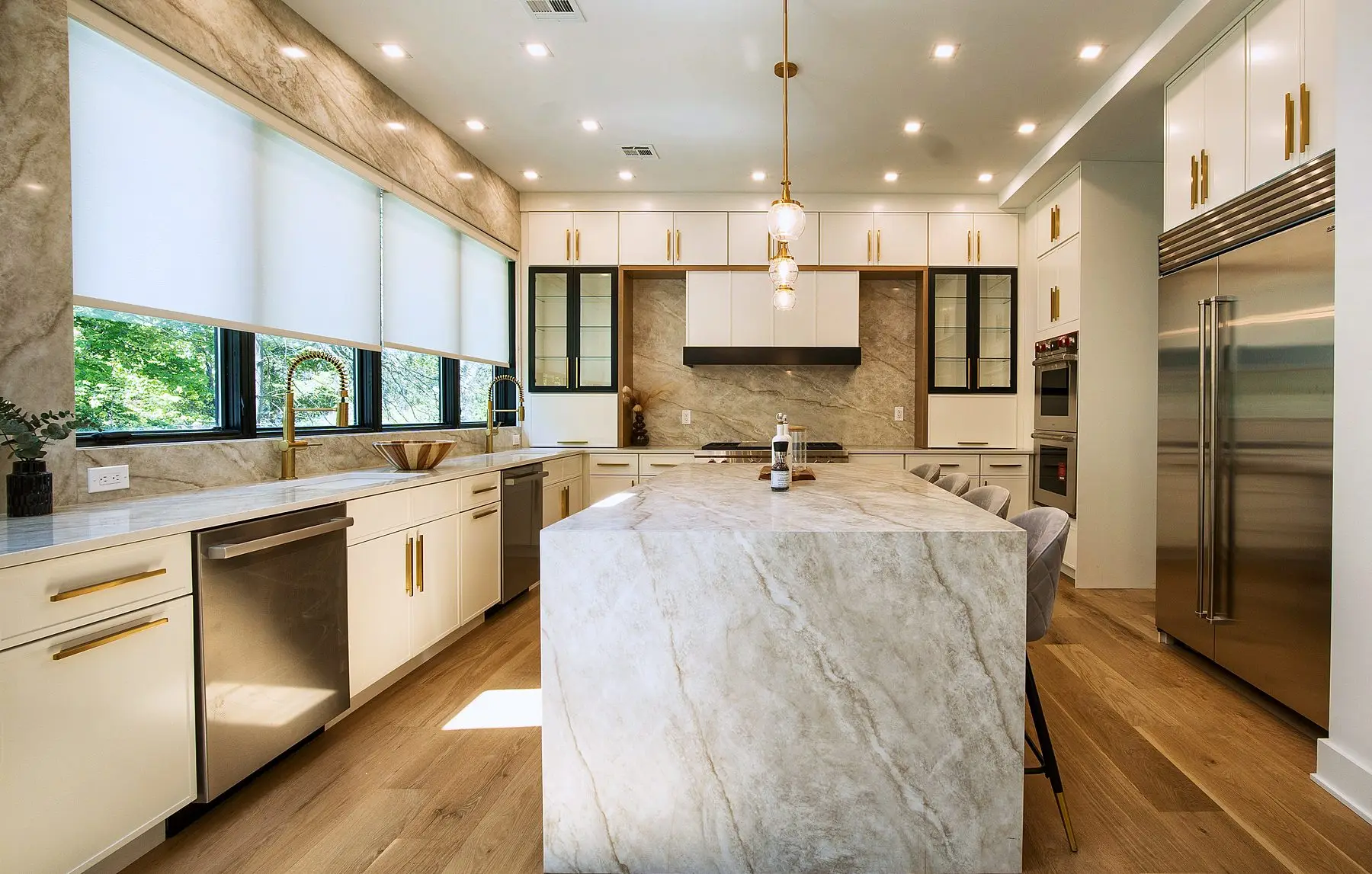
Quartzite waterfall island in a Dove Luna kitchen with Timber accents — see this project
Quartz: engineered, consistent and low-maintenance
Quartz countertops are an engineered product: crushed quartz mineral bound with resin and pigment, pressed into slabs and polished. Because it is made in a factory, the color and pattern are consistent from slab to slab, and the surface is non-porous, so it never needs sealing and shrugs off wine, coffee and oil. It is the material most of our customers choose, and the one we recommend for busy family kitchens by default.
Two cautions. The resin does not love heat: a hot pan straight from the burner can scorch or discolor the surface, so trivets are a habit worth keeping. And most quartz is not rated for outdoor use, because sunlight yellows the resin over time. Patterns range from solid colors to convincing marble looks with flowing veins, and the current demand in our showrooms is for warm, creamy backgrounds with soft veining rather than stark white.
Quartzite: natural stone with a marble look and granite toughness
Quartzite is a natural metamorphic rock, formed when sandstone is heated and compressed over a very long time. Despite the name, it has nothing to do with engineered quartz. True quartzite is very hard, often harder than granite, and it handles heat the way natural stone does. The reason people fall for it is the look: soft whites and grays with flowing veins and translucency that engineered products imitate but do not quite match. Every slab is unique, which is both the appeal and the reason you should pick your actual slabs in person.
It is porous, so it needs sealing, typically once a year, and it costs more than quartz, often roughly a third to a half more installed, with the most sought-after slabs well above that. One thing to know: some stones sold as quartzite are softer and etch like marble. A reputable supplier will tell you which is which, and we test samples with lemon juice and a knife point before we recommend one.
Granite: the proven natural stone
Granite was the default upgrade countertop for two decades and is still an excellent material. It is a hard igneous stone, tolerates hot pans, resists scratches and comes in an enormous range of colors. It needs periodic sealing, though dense, dark granites need it rarely. Pricing has become very reasonable for common colors, often similar to mid-range quartz or lower.
In our showrooms the demand has shifted away from the speckled, busy granites of the 2000s toward quieter stones: honed blacks, soft whites with gray movement, and the leathered finishes that give a matte, textured surface. If you want a natural stone on a moderate budget, granite remains the practical answer.
Porcelain and sintered surfaces: thin, tough and heatproof
Porcelain slabs and sintered surfaces such as Dekton are made from mineral powders fired or compacted at very high temperatures. The result is a dense, non-porous surface that is essentially unaffected by heat, sunlight, stains or scratches, which makes it the material we suggest for outdoor kitchens and for homeowners who want to set a hot pan down anywhere. Slabs are large and relatively thin, which allows waterfall islands and full-height backsplashes with a slim, modern profile, and book-matched marble looks across an entire wall.
The trade-offs: edges are more vulnerable to chipping than quartz, so edge profiles are usually mitered or kept simple; the pattern on many porcelain slabs is printed on the surface, so a deep chip can show the body color underneath (some sintered products carry the pattern through the slab); and fabrication requires a shop with the right experience, which we insist on. Thin slabs are often installed over a substrate for support.
Side by side: heat, stains, scratches, sealing and outdoors
- Heat: porcelain and sintered surfaces best, then granite and quartzite, then quartz (use trivets).
- Stains: quartz and porcelain are non-porous and resist everything; sealed granite is very good; quartzite needs its seal maintained.
- Scratches: all four resist normal use; porcelain and quartzite are hardest; quartz can be marked by a stray knife but hides it well in busy patterns.
- Chips: granite and quartz are the most forgiving at edges; porcelain and some quartzites need more care at sink cutouts and corners.
- Sealing: quartz and porcelain never; granite occasionally; quartzite yearly.
- Outdoors: porcelain, sintered surfaces and granite yes; quartz no, with rare exceptions.
- Repairs: granite and quartzite chips can be filled nearly invisibly; quartz repairs are possible but more visible; porcelain repairs are the hardest.
Looks: veining, matching and seams
The look you want often decides the material. For a consistent color or a repeatable pattern, quartz wins; what you see in the sample is what you get. For a one-of-a-kind stone with depth and translucency, quartzite or granite, chosen slab by slab. For a dramatic book-matched marble wall or a very thin edge, porcelain.
Seams matter in every material. A typical island fits on one slab, but a long L-shaped kitchen will have at least one seam, and a good fabricator places it where it is least visible and matches the pattern across it. Veined quartz and porcelain are harder to seam invisibly than solid colors, and the direction of the vein across a corner is a decision we make with you at template. The island seating guide covers the overhang limits that also depend on the material.
Cost, in relative terms
Installed, the ranges overlap more than people expect. Entry quartz and common granites sit at the low end. Designer quartz, premium granite and most porcelain are mid-range, with porcelain fabrication adding to the material cost. Quartzite and the most elaborate porcelain and sintered slabs are at the top, with exotic quartzites the most expensive surfaces we sell. Thickness, edge profile, cutouts, a waterfall end and a full-height backsplash each add to any material. Because the ranges overlap, we price two or three options for most kitchens so you can see the difference for your layout rather than in the abstract. Our countertops page lists what we carry.
The brands in our showrooms and how they differ
- Reliance Quartz: our everyday quartz line, with solid colors and marble looks at a value price. The usual choice when quartz is the goal and the budget matters.
- MSI Q quartz and natural stone: a very wide quartz palette, including popular Calacatta-style looks, plus MSI's granite, quartzite and marble slabs.
- Silestone: Cosentino's quartz brand, with a broad designer palette and newer formulations developed with lower crystalline silica content, part of an industry-wide move toward safer fabrication.
- Caesarstone: a long-established quartz brand with designer-led colors and some of the most convincing concrete and honed looks, and now porcelain as well.
- Dekton: Cosentino's ultra-compact sintered surface, our go-to for heat and outdoor use and for large-format, book-matched designs.
- Ēclos by Cosentino: Cosentino's newest surface line, which we are adding to our displays; ask us for current samples and the latest specifications.
Our tile partners, including MSI, carry the porcelain slabs we use for backsplashes and full-height walls; see our tile collections.
Fabrication and installation: what to expect
Countertops are templated after the cabinets are installed, not before, because the final dimensions depend on the real walls. The fabricator measures with a digital template, you approve the seam placement and the slab layout, the tops are cut and polished, and installation usually takes a few hours. Between template and install there is typically a week or two with plywood or no countertop, which is why we schedule the plumber's final connections and the backsplash for after the tops go in. Our kitchen remodel timeline guide shows where this falls in the overall schedule. We handle templating, fabrication and installation as part of the job, so there is one point of contact if a seam or an edge is not right. The same four materials, and the same trade-offs, apply to vanity tops; our bathroom vanity buying guide covers what changes in a wet room.
Bottom line
For most New Jersey family kitchens, quartz is the sensible default: consistent, non-porous and easy to live with. Choose quartzite if you want the depth of real stone with a light, veined look and you will keep up with sealing. Choose granite for a natural stone on a moderate budget. Choose porcelain or Dekton for heat, outdoor use and thin, dramatic slabs. The best way to decide is with samples on your cabinet door under your light, which is what we do at any of our showrooms, and it helps to see how these materials fit with the colors and finishes people are choosing right now.
Questions on this topic
Is quartzite the same as quartz?
Can I put a hot pan on a quartz countertop?
Which countertop is best for an outdoor kitchen?
Do countertops get installed before or after the cabinets?

Turn the reading into a plan.
Send this and a designer will call within one business day to arrange a showroom visit or a measurement. No obligation.
Or send the details and we'll call you